BBC - Doctor Who Classic Episode Guide - The Tomb of the Cybermen - Details
Season 5, Story 1 (Complete Series Story #37) | Previous - Next | Index
Power. Maybe it's because I'm also watching
Game of Thrones these days, this story struck me as hitting on some of the same themes with regard to treachery and the nature of power. Certainly, when dealing with the Cybermen, there's the whole fear of runaway technology and human augmentation, so I don't mean to downplay that aspect of the Cybermen as an effectively creepy adversary ... but when we ask ourselves who was the real enemy in this story, I think we have to say it was Kaftan and Klieg, the power mad schemers out to usurp the scientific expedition to Telos for their own nefarious ends -- though I honestly can't say I ever quite understood what organization they were acting on behalf of while watching. (I looked it up after and learned they were members of the
Brotherhood of Logicians, a group with brains and ambition, but no brawn to back it up.)
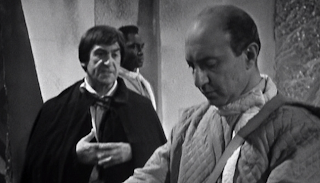 |
| So, Klieg, whatcha doin' there? |
There's a clumsy attempt to make Boolean logic a part of the story, but that's never done in a way that I think was meant to fool anyone but 6-yr-olds. You just can't expect much of the technobabble to make sense in these old stories. What I like about this episode though is the audience is shown, not told, that there are some questions that, had the they been asked, might have saved the expedition a lot of trouble, questions like: Where's the money coming from? What are the motives of the people funding the expedition? We can understand the desire to learn about the Cybermen, but it was surely the height of folly to go poking around their tombs blindly trusting that the only motive of all parties was simply the pursuit of knowledge. And, we can reasonably ask, was the pursuit of knowledge in this case worth the risk?, which is good practice for thinking about medical ethics and a host of other issues that are still relevant decades after this episode was produced.
There's a great deal of skepticism about science in this one. The scientist nominally in charge of the expedition is a short-sighted buffoon, so caught up in looking at cybertechnology, he can't see the peril standing right next to him. Klieg, is presented to us as a brilliant logician and scientist, but he's a megalomaniac. Then there's the archeologist chappie who's main character trait seems to be cowardice. If it weren't for the Doctor, you'd think the message of the show was "Scientists can't be trusted!"
I chose the quote for this post title first because it made me laugh out loud when Troughton delivered the line, but it also speaks directly to the Doctor's willingness to pick up stray humans and drag them into insanely dangerous adventures. We can forgive the Doctor though, because ultimately Victoria and Jamie know what they're getting into. Or, at least they are making the choice to explore even though they don't know exactly what they're getting into. The Doctor is a Time Lord and he's got a TARDIS, so some of the risk is mitigated anyways. We aren't so forgiving of the members of the expedition to Telos though, who know, or ought to know, their technology doesn't stack up against the Cybermen. This is one where the Doctor looks more irresponsible in retrospect, because the fate of all the team hung on Toberman's ability to resist the Cyber Commander's programming.
As long as we're talking about Toberman, let's deal with this instance of the mute, black strongman. (See,
"Terror of the Autons" for another.) I mean, WTF? I know it was 1967 and the world wasn't quite to our level of post-racial harmony where black kids can walk the streets at night with skittles in their pocket comfortable in the knowledge they won't be shot down by a racist vigilante protected by NRA-sponsored laws protecting white people from prosecution when they hunt black people. But still ... it's very difficult to stomach this sort of portrayal even acknowledging that racist stereotyping was part of the TV landscape in the mid-20th century. If Toberman hadn't been granted the small measure of dignity of getting a heroic end, I'd be even less inclined to forgive this story. As it is, I'm reasonably comfortable that we can watch this without dismissing it as utterly hateful racist propaganda; instead, I think we can acknowledge that the production staff had some retrograde ideas about skin pigmentation we can understand as a product of the times and not quarantine it as unwatchable. We shouldn't deny it's a problem, nor should we just dismiss it as only a problem of a bygone age. Because, unless you missed the sarcasm earlier, we still live a society that deals with its disgusting history of savage oppression and cruel denial of basic human and civil rights by enacting voter ID laws and imprisoning an
incredible number of black men.
The other brilliant comic moment, by the way, occurs very early when the Doctor puts his hand out to guide Victoria (a young 19th century girl who lost her father in the previous story to the Daleks) into tomb of the Cybermen, through a door that just electrified another member of the expedition. The funny bit is that Jamie reflexively grabs the hand offered to him, and both he and the Doctor react with a classically awkward heteronormative hand-dropping. The crazy thing is that he is bringing Victoria and Jamie into what is clearly a dangerous situation.
 |
| GIF-able moment if there ever was one. |
If this story were nothing more than it's plot and atmosphere, it wouldn't have much interest to us, but because of the themes and the great chemistry between Patrick Troughton and Frazer Hines, it stands out despite being a little over its own head.


